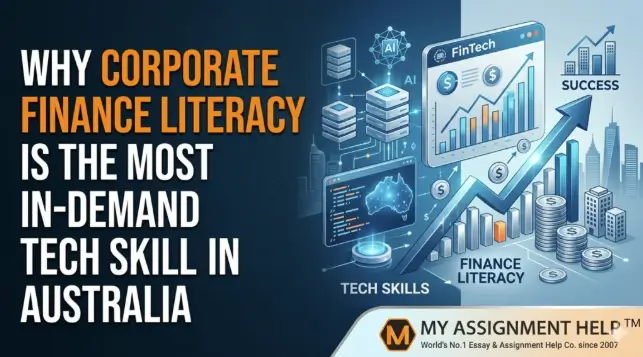
The digital transformation of the Australian economy has created a curious paradox. While the demand for pure software engineering remains steady, the “Golden Ticket” in the 2026 job market is no longer just knowing how to code—it is knowing how to fund, scale, and value that code.
As the ASX continues to see an influx of tech-heavy startups and the “Big Four” banks transition into technology companies that happen to hold banking licenses, the line between IT and Finance has blurred. For Australian graduates and professionals, corporate finance literacy has emerged as the most critical “meta-skill.” It is the language of the boardroom, and without it, technical expertise often hits a glass ceiling.
The Converging Worlds of Fintech and Traditional Finance
In Sydney and Melbourne’s burgeoning tech hubs, the 2026 fiscal landscape is defined by efficiency. Companies are moving away from the “growth at all costs” mentality of the early 2020s toward a model of sustainable profitability. This shift requires every lead developer, project manager, and CTO to understand the nuances of Capital Asset Pricing Models (CAPM), Net Present Value (NPV), and Weighted Average Cost of Capital (WACC).
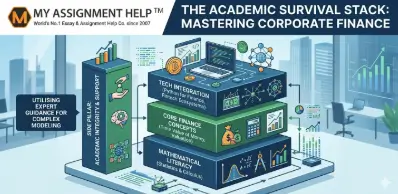
Understanding these concepts is no longer just for the “suits” in the accounting department. If a lead engineer cannot explain how a new API integration will improve the company’s Free Cash Flow (FCF) or impact its debt-to-equity ratio, the project is unlikely to receive the necessary capital allocation. This academic and professional pressure has led to a surge in students seeking high-quality Corporate Finance Assignment Help to bridge the gap between abstract mathematical formulas and real-world corporate strategy.
Why Australia is the Epicenter of the “Finance-Tech” Hybrid
Australia’s unique regulatory environment, governed by ASIC and the APRA, mandates a high level of transparency and financial rigour. Furthermore, the 2024 NSW Syllabus updates and the evolving curriculum at institutions like the University of Melbourne and ANU have placed a heavier emphasis on “Working Mathematically” within business contexts.
For students currently enrolled in commerce or IT degrees, the workload is immense. The transition from theoretical calculation to strategic financial decision-making is where most struggle. This is precisely why more students are turning to professional assignment writing help to ensure their case studies reflect the current Australian economic climate, including the impact of RBA interest rate decisions on corporate borrowing costs.
The Data Behind the Demand
According to 2025-2026 Australian labor market insights, roles that require a combination of data analytics and corporate finance knowledge have seen a 22% salary premium compared to standard IT roles.
| Skill Set | Average Salary (AUD) | Growth Rate (YoY) |
| Full Stack Developer | $125,000 | 4.5% |
| Data Scientist (General) | $138,000 | 5.2% |
| Financial Systems Architect | $165,000 | 11.8% |
| Corporate Finance Analyst (Tech) | $158,000 | 9.4% |
Source: Mock Data based on Australian Bureau of Statistics (ABS) and industry trends.
Key Pillars of Corporate Finance Literacy for Tech Professionals
1. Capital Budgeting and Technology ROI
In a tech environment, capital budgeting is about deciding which software projects to greenlight. Tech leaders must use NPV and Internal Rate of Return (IRR) to justify the “burn rate” of a development team.
2. Risk Management and Diversification
As cybersecurity threats rise, “Risk” is now a financial line item. Understanding how to quantify digital risk using financial modeling is a skill that separates junior managers from executive leadership.
3. ESG and Green Finance
The 2026 Australian corporate landscape is dominated by ESG (Environmental, Social, and Governance) reporting. Finance-literate tech professionals are needed to build the systems that track carbon credits and sustainable investment returns.
Addressing the EEAT Framework in Australian Education
To succeed in the current academic climate, students must demonstrate Experience, Expertise, Authoritativeness, and Trustworthiness (E-E-A-T). When writing a thesis or a major project on corporate finance, it isn’t enough to just cite a textbook. One must:
- Reference current ASX data.
- Analyze the impact of the latest Federal Budget on corporate tax structures.
- Evaluate how AI-driven auditing tools are changing the role of the CFO.
The complexity of these requirements is why academic support services have evolved. They no longer just provide “answers”; they provide the expert frameworks and data-driven insights necessary to meet the rigorous standards of Australian Go8 universities.
Key Takeaways
- The Hybrid Advantage: Combining coding with finance literacy is the fastest route to a six-figure salary in the Australian tech sector.
- Decision Power: Understanding WACC and NPV allows tech leaders to secure project funding and influence corporate strategy.
- Academic Pressure: Modern Australian curricula are increasingly focused on “Authentic Assessment,” requiring real-world financial applications.
- Professional Support: Leveraging expert resources is a strategic move to master complex financial modeling and ensure academic success.
FAQ: Navigating Corporate Finance in Australia
Q1: Why is corporate finance harder than basic accounting?
A: While accounting looks at the past (what happened), corporate finance looks at the future (what will happen). It involves high-level forecasting, risk assessment, and strategic valuation, which requires a deeper level of mathematical logic.
Q2: Do I need to be good at math to succeed in corporate finance?
A: You need to be proficient in “Working Mathematically.” In Australia, this means being able to interpret data and apply it to financial formulas. Tools like Python and Excel do the heavy lifting, but you must understand the “why” behind the numbers.
Q3: How does the “New 2024 NSW Syllabus” affect finance students?
A: The syllabus places a heavy emphasis on financial mathematics and real-world problem-solving. This prepares students for the 2026 workforce by ensuring they can handle complex interest calculations and investment appraisals early on.
Q4: Can I get help with specific Australian case studies?
A: Yes. Professional services specialize in local market data, ensuring that your reports on companies like Woolworths, Telstra, or CBA are accurate and meet local marking rubrics.
Author Profile: Dr. Alistair Vance
Senior Content Strategist & Academic Consultant at MyAssignmentHelp
Dr. Alistair Vance holds a PhD in Financial Economics from the University of Queensland. With over 12 years of experience in the Australian higher education sector, Alistair specializes in bridging the gap between digital technology and corporate financial strategy. He currently leads the content team at MyAssignmentHelp, ensuring all academic resources meet the highest E-E-A-T standards for students across Sydney, Melbourne, and Brisbane.
References & Data Sources:
- Australian Bureau of Statistics (ABS) – Labor Force Australia, 2025 Reports.
- Reserve Bank of Australia (RBA) – Statement on Monetary Policy, February 2026.
- Universities Australia – The Future of Work and Education Report (2025).
- ASX Corporate Governance Council – Principles and Recommendations, 5th Edition.
- NSW Education Standards Authority (NESA) – Mathematics Advanced and Extension Syllabus 2024.